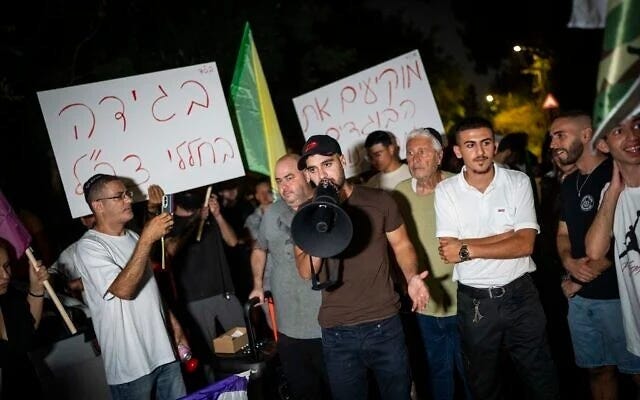
On September 16th, dozens of Israelis gathered outside the home of Israeli filmmaker Rachel Szor’s parents and called for her death, chanting “Death penalty for traitors!”
What drove the Israelis into a homicidal fever was NAZA, an 80-minute documentary made by Szor and fellow Israeli filmmaker and journalist Yuval Abraham that takes viewers inside the Israeli military’s systems for surgically tracking Palestinians and determining how much civilian death can be accepted in a single strike.
Between 2023 and 2025, Abraham and Szor conducted nighttime interviews with 24 Israeli soldiers and intelligence operatives to provide viewers “a window into systems of mass killing.”
Prime Minister Benjamin Netanyahu called the positive response to the film a “global antisemitic incident” and promised to introduce legislation allowing him to revoke the Israeli citizenship of the filmmakers.
The film is divided into four sections, each examining a different component of Israel’s targeting and surveillance apparatus, explained almost entirley by the soldiers and intelligence personnel who designed, operated or witnessed these systems.
The first section is “Lavender,” an artificial-intelligence-assisted targeting system that Israel uses to generate potential targets in Gaza. The existence of Lavender was first reported publicly in an April 2024 investigation by +972 Magazine, written by Abraham himself.
Officially, Lavender was designed to identify suspected members of Palestinian militant organizations, including low-ranking operatives, and generate targets for military strikes. According to an Israeli intelligence source who spoke to +972, nearly 40,000 Palestinians in Gaza were identified as possible militants and therefore bombing targets during the first weeks after October 7th.

In NAZA, one of the soldiers picks up a marker and begins drawing on a paper bag what he says the screen would look like when Lavender generated a target. He draws several buildings from the perspective of a drone.
“Our target is on the sixth floor. We know there are eight other people in his apartment and 13 other people on the floors below him. So that’s 21 NAZA.”
NAZA, from the Hebrew phrase nezek agavi (נזק אגבי), is the Israeli military term for collateral damage and the word from which the documentary takes its title.
According to the soldiers who spoke anonymously, they’re allowed to carry out a strike with 20 NAZA (20 innocents killed) without any additional authorization. But soldiers recalled getting the green light to bomb buildings, markets and neighborhoods with as many as 500 NAZA.
“That’s an entire Israeli town,” Abraham told a soldier who described participating in strikes with more than 500 anticipated civilian deaths. “Yeah,” the soldier responded.
“We say NAZA,” another soldier explained. “We don’t say collateral damage. And we definitely don’t say innocent women and children.”
According to the interviewed soldiers, roughly 250,000 structures in Gaza have been assigned identifying numbers by the Israeli military. Palestinians carrying cell phones are also assigned numerical identifiers and can be continuously tracked and monitored.
“Every single capability a cell phone has, a microphone, a camera, a GPS, anything. We have the ability to hack into a device and use all of its capabilities to our advantage,” one soldier says.
“We will see a 12-year-old girl text her mother that daddy just got home, and we know it’s time to bomb the building.”
“So you spy on a 12-year-old and then kill her father?” Abraham asks.
“We spy on the 12-year-old girl and then kill her and her whole family,” the soldier responds.
The film then explained another automated military system called “Where’s Daddy?”
The system, as described in the film, is designed to identify suspected Palestinian militants, locate their cell phones and alert Israeli targeting personnel when the phone enters the target’s family home, allowing the military to strike the building.
“This idea that the fighters in Gaza use their children as human shields is not true. The truth is, they are just going home. It’s just a normal family home. There’s no type of military purpose of the house. They aren’t making weapons or storing weapons. It’s just easier to kill them at home instead of when they’re out running around,” one soldier says.
One soldier recalled hacking into a target’s phone and going into his photographs, where he found ordinary selfies of the man with his two young daughters. The system then alerted the soldier that the target’s phone was inside the house, and he sent two missiles into the building, killing everyone inside, including the daughters.
“We later learned that the target just left his phone at home that day. So we actually killed the family and not the target,” the soldier tells Abraham.
“What ended up happening to the dad?” Abraham asks.
“I don’t know. He probably was killed eventually. If they want you dead, you’ll die. That’s how it works, pretty much,” the soldier responds.
One soldier says he was personally involved in strikes that killed more than 3,000 people.
“The bodies, the bodies are just everywhere in Gaza,” another former soldier who operated inside the Strip told Abraham.
One soldier describes snipers killing Palestinians who ran to collect food. He picked up a marker and drew a small foot bridge that Palestinians needed to cross to reach a food distribution point. The Israeli soldiers, he explained, decided that Palestinians were not allowed to run underneath the bridge in order to reach the food faster. They could only be on top of the bridge. And so when Palestinians crossed this invisible line underneath the bridge, they were sniped.
The soldier recalls piles of dead Palestinians accumulating in areas where the Israeli army had established what he describes as kill zones marked by imaginary lines without informing Palestinians of these imaginary lines.
“I saw dogs eating bodies from the drone camera,” one soldier said. “And I’m sparing you the really bad stuff.”
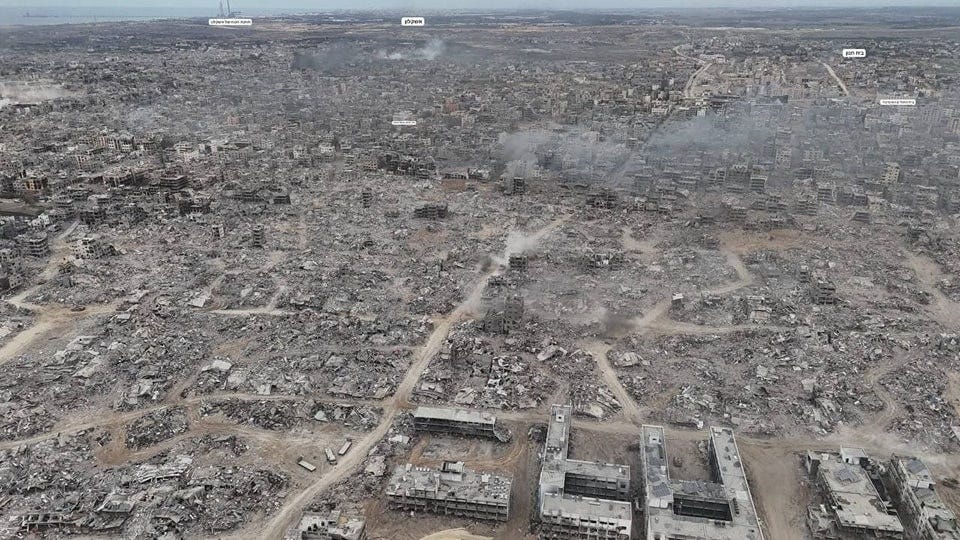
One solider put it bluntly: “Our objective was to bomb as many buildings as we could. To clean as much of Gaza as we could before losing international legitimacy.”
The film also examined the psychological consequences (or lack there of) of taking part in such a murderous project.
“The military thought that because of all of the bombing and killing we might need psychological help. They wanted to bring in therapists,” one soldier recalled. “But there was just no need. No need at all. We were so into it.”
While criticisms of NAZA from the Pro-Israel side were expected (and perhaps it’s unfair to use the word “criticism” to describe calling for the death of the filmmakers) – there was some serious critism from Palestinian activists and journalists who argued that granting confidentiality and anonymity to war criminals blocks justice and accountability.
Nerdeen Kiswani, the co-founder and chair of the Palestinian activist group Within Our Lifetime, wrote that Abraham and Szor should “immediately release the names of every soldier to whom they granted confidentiality… while documenting admissions of war crimes,” calling it “fundamentally perverse” to center Israeli confessions while protecting the speakers from identification.
Ali Abumnimah, a Palestinian-American journalist and founder of the Electronic Intifada criticized both the Hollywood-style exclusivity of the film, releasing it in select theaters and film festivals, as opposed to online for free and for everyone, and also criticizing the anonymity given to the 24 soldiers who admitted to all types of barbaric war crimes.
On 15 September he called for an immediate free online release: “I call on @yuval_abraham and his colleagues to immediately release ‘NAZA’ online for free for the whole world. I understand that this will exclude it from the Oscars and other awards, but if it’s so urgent to help stop the genocide, that’s the only moral thing they can do, especially as Israelis. Release NAZA online now!”
On September 24th, Yuval Abraham announced NAZA, “due to interest and public importance” would be released on the Guardian website in November.
“For weeks I called for this, only to be angrily lectured that this was impractical and that it would have a far bigger impact if restricted to red carpet galas and traditional commercial distribution channels. They should have done this from the start,” Abunimah tweeted. “And we should not stop demanding that Abraham and his colleagues turn over any and all evidence they have that could lead to the arrest and punishment of perpetrators of war crimes, crimes against humanity and genocide to the International Criminal Court.”
Last week, Israeli directors Hagai Gutman and Ariel Averbuch released a counter-film intended to discredit NAZA. It is also titled NAZA.
The film likewise interviews Israeli soldiers, this time on nighttime rooftops in Tel Aviv. But instead of soldiers describing their participation in Israel’s targeting and surveillance systems, they repeat virtually every major justification the Israeli military has offered for its conduct in Gaza since October 7, including claims that houses, hospitals and schools are used as weapons depots or human shields, along with claims about the IDF’s ability to distinguish between civilians and fighters.
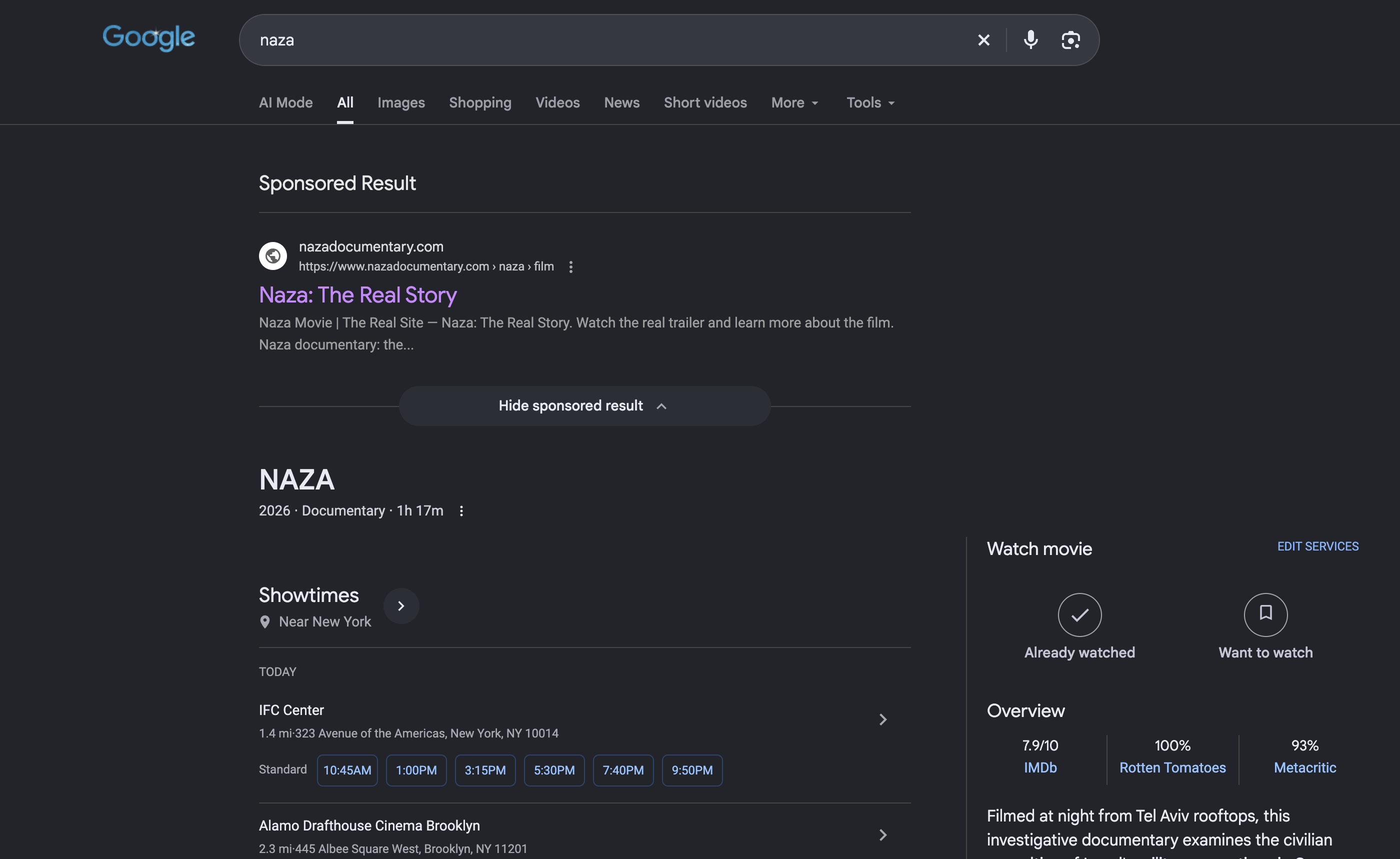
The film is so poorly made and so transparently propagandistic that its purpose is difficult to mistake. But by using the same exact title as Abraham and Szor’s documentary, it does something more effective than simply attacking the original film. A Google search for NAZA now returns the Pro-IDF counter-film as the first result, pushing the actual documentary below it.